HISTORY
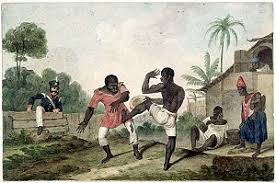
Capoeira Angola is a Brazilian martial art that combines elements of combat, dance, music, and acrobatics. It’s origins date all the way back to the 16th century and was developed in Brazil mainly by enslaved black people, like Angolans, brought to work on the sugar cane plantations.
Since 2014 it’s protected by the UNESCO as an “intangible cultural heritage” but its way to such status was rough and full of oppression, during a period in its history it was even banned by law!
Capoeira was born inside the communities of enslaved people, living on the plantations, as a mean of survival and only tool to defend themselves against the police when they would attempt to escape from their misery.
People who managed to escape started to establish settlements, called Quilombos, away from the oppressors. The Quilombos grew fast attracting fugitives from all around and quickly turned into multi-ethnic independent states. The biggest and most famous one was called Quilombo dos Palmares. In them, an environment was created where people could practise their traditional cultures and where Capoeira was able to evolve in a martial art.
In the 18th century we find the first documented traces of Capoeira being practiced in the big cities such as Salvador da Bahia and with the influx of more enslaved and growing social life in the cities, Capoeira gained popularity and started being practice by more and more people.
It was often used to fight against the colonial guards and some police records from the 19th century show numbers of people being arrested for Capoeira.
After the abolishment of slavery in 1888, former enslaved people found themselves jobless, hated and stigmatized by the Brazilian society. It was virtually impossible for them to get respected jobs and with new waves of immigrants from Europe and Asia the situation got worse.
Because of the difficult economic situation, crime and chaos started to rise, the Brazilian government decided to prohibit Capoeira in the year 1890. They saw it as an advantage in fighting and could pose a threat to bringing order on the streets of the big cities.
It was an attempt to strip the oppressed from opportunities to fight back.
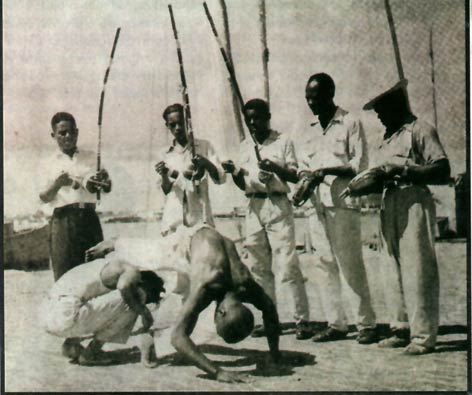
The repression has declined in the first decades of the 20th century and around that time Mestre Bimba, a renowned fighter from Salvador de Bahia, started to develop first systematic training methods for Capoeira. In 1932 he opened the first school named Centro de Cultura Física e Luta Regional. His style was called Luta Regional Baiana because Capoeira was still officially illegal.
In the year 1940 Capoeira was finally legalized and in 1941 Mestre Pastinha founded the Centro Esportivo de Capoeira Angola in order to preserve the traditional Capoeira form.
In the 70’s mestres started to travel outside of Brazil and teach this art and establish schools all around the world. Today we have Capoeira groups on all the continents which makes it an important element in the promotion of afro-brazilian culture. Thousands of people travel every year to Brazil and different countries to learn Capoeira.
It has become an international symbol of resistance to oppression and a symbol of pride for the Brazilian people, especially to African descendents whose ancestors fought with blood to keep it alive.
THE RODA
Roda is the ritual moment when capoeira players – capoeristas form a circle along with the instruments and two by two enter and play the game accompanied by traditional singing and music – mostly in brazilian portuguese) . The duration of the game is determined by one of the berimbau players who “calls” for the game to start or finish. It’s final goal is not to knock out the opponent but rather to show skill. A certain communication is established while players test each other.
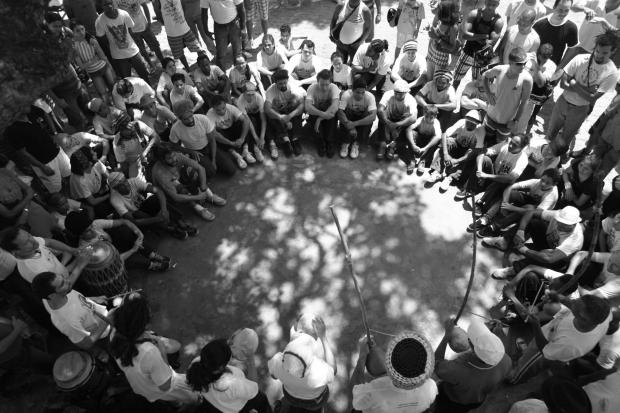
A capoeira roda in Brazil
Capoeira is a simulated combat and usually there is no direct contact, although more experience capoeristas can use movements like rasteiras and cabeçadas to take the opponent down without hurting them and letting them get back in the game.
Acrobatics and theatrical movement is also a part of the game and displays the players personal style making the game more aesthetically interesting.
INSTRUMENTS
A traditional Capoeira Angola bateria consists of 8 instruments. They include three berimbaus with three different pitches (berra-boi, gunga and viola), two pandeiros, a reco-reco, an agogô and an atabaque
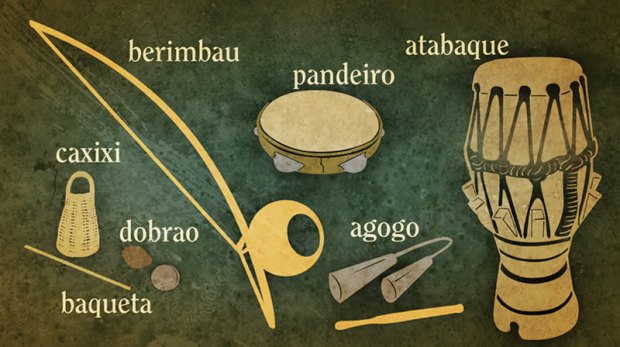
 Angoleiros do Sertão • Berlin